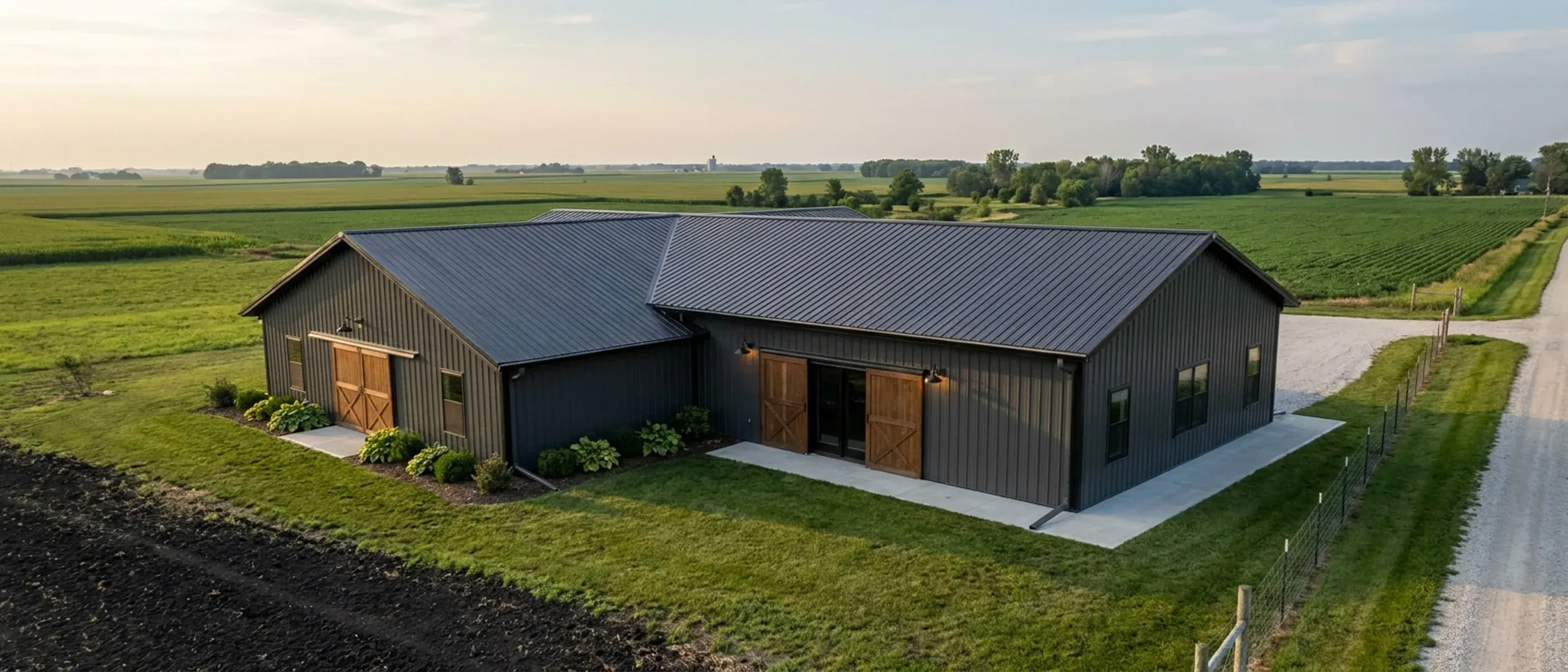
Are Barndominiums Legal in Illinois? Codes, Permits and Zoning
Illinois does not issue residential building permits. Your city, village or county does, if it has adopted a building code, and many rural counties have not. That is why the honest answer to whether a barndominium is legal in Illinois is yes, followed by a question: legal under whose rules? State law does not single out barndominiums as a building type. What it does is set the conditions every home must meet wherever it is built. Since January 1, 2025, any building code a city, village or county adopts must regulate structural design at least as strictly as the International Residential Code. Where no local code applies, the Illinois Residential Building Code Act requires the construction contract for a new home to name the code it will be built to. The Illinois Energy Conservation Code applies to new homes across the state, a passive radon pipe is required in every new home, and septic systems and wells are permitted under state health rules through your county health department. This guide walks through who regulates your land, what applies where nobody inspects, how zoning and farmland rules shape the project, and what to ask before you buy a parcel.
Figures on this page are cited third-party or government data, not a quote from Illinois Barndominium Builders.
Bottom Line Up Front
- A barndominium is a house in Illinois law. It is permitted by your city, village or county under whatever code that local government has adopted, and the state itself does no plan review, permitting or inspection for private homes.
- Where no local building code applies, the code still exists: the Illinois Residential Building Code Act (815 ILCS 670) makes the construction contract name one, and if it names none, the current International Residential Code, the Illinois Energy Conservation Code and the Illinois Plumbing Code become part of the contract by law.
- Zoning, septic, well and radon rules apply whether or not anyone inspects the framing, and on farmland the zoning question (minimum lot size, one home per so many acres) often decides the project before the building code does.
Who regulates your parcel: the five answers in Illinois
Start with the parcel's legal location, not its postal address. A rural mailing address can sit inside a village's limits, and a town name on the envelope can cover unincorporated land the county controls.
Inside a city, village or incorporated town
Municipalities may prescribe how buildings are constructed (65 ILCS 5/11-30-4), and most that adopt a code issue their own permits. If your land is inside municipal limits, the city or village building department is your first call, whatever the county does outside those limits.
Unincorporated land in a county that has adopted a code
A county board may regulate the construction of buildings outside cities, villages and incorporated towns under 55 ILCS 5/5-1063. Many do. Kane County, for example, requires building permits for all new construction in unincorporated Kane County and has adopted the 2021 International Residential Code. Peoria County enforces the 2018 I-Codes, effective July 1, 2021. Kendall County's codes, effective May 11, 2026, include the 2024 International Residential Code. Editions differ from one county to the next, so ask for the edition in force on your permit date.
The collar counties' countywide power
A separate statute, 55 ILCS 5/5-1064, lets counties in the northeastern Illinois planning region with fewer than 1,000,000 people adopt building rules that apply throughout the county, except in municipalities that enforce an equal code. Which collar counties use this power rather than 5-1063 is a county-by-county question. Either way, the practical step is the same: call the county building division and ask whether it or the municipality issues your permit.
Chicago and unincorporated Cook County
Chicago has its own Chicago Construction Codes, adopted and amended by the city council, and permits come from the Chicago Department of Buildings. Unincorporated Cook County has its own Department of Building and Zoning, which adopted provisions of the 2021 International Residential Code for all of unincorporated Cook County. Neither is the Illinois rule, and neither applies outside its own territory.
Unincorporated land with no county building code
A county is not required to adopt a building code. Where it has not, the area is a non-building code jurisdiction. You may still need a county zoning or filing permit: in Williamson County, for instance, a building permit application is filed with the Supervisor of Assessments under a county ordinance that names no building code. The construction standard in these places comes from the contract under 815 ILCS 670, and the septic, well, radon and energy rules still apply.
How to confirm which answer is yours
Ask the county building or zoning office three questions in writing: is this parcel inside any municipality's limits, does the county enforce a residential code here and which edition, and who issues the septic and well permits. The Capital Development Board publishes the codes local governments report to it in its Illinois Code Directory, which is a useful cross-check but not a substitute for the local office's answer.
What applies where nobody inspects
No permit and no inspector does not mean no code. In a non-building code jurisdiction, Illinois law moves the code from the permit office into the contract.
The contract must name a code
Under 815 ILCS 670/15, a contract to build a new single-family home in a non-building code jurisdiction must adopt a residential building code agreed by the home builder and the buyer: the International Residential Code (current or preceding edition), or any municipal or county residential code in effect within 100 miles of the new home. Read the contract for that clause before you sign.
If the contract is silent
If the builder and buyer fail to agree, or no code is stated, the current International Residential Code, the Illinois Energy Conservation Code and the Illinois Plumbing Code become part of the construction contract by law. A buyer in a no-code county is therefore still owed a house built to a recognised standard.
Nobody checks it for you
The Act puts the standard in the contract, not an inspector on site. If you want independent eyes on the footings, framing and rough-ins in a place with no inspections, arrange third-party inspections at those stages before work starts and write them into the schedule.
No design professional required, usually
The Illinois Architecture Practice Act does not require an architect for a detached single-family residence on a single lot, unless a local ordinance requires one (225 ILCS 305/3). The Capital Development Board notes that residential projects do not typically require a licensed design professional. Some counties set their own triggers: Will County requires documents signed and sealed by a registered design professional for all new one- and two-family residences, and Kane County requires sealed designs for pier-supported detached accessory buildings.
Trades the state does license
Illinois has no state licence for general contractors or home builders, and no state electrical licence. It does license roofing (225 ILCS 335) and plumbing (225 ILCS 320). On a barndominium home, the roof is installed by a licensed Illinois roofing contractor and the plumbing by licensed Illinois plumbers. The one exception in the plumbing law is an owner building a single-family home for their own occupancy, who may do their own plumbing to the Illinois Plumbing Code.
Farmland, zoning and the two agricultural carve-outs
Illinois has two separate farm carve-outs, one in the county building-code statute and one in the county zoning statute. They are often merged into a single claim that barndominiums on farmland are exempt. They are not.
The building-code carve-out: farm residences
The county building-code power in 55 ILCS 5/5-1063 excludes buildings for agricultural purposes on farms, including farm residences. Some counties repeat that in their own codes: Tazewell County's code does not apply to agricultural buildings on an operating farm, including farm residences, and Williamson County's ordinance uses the same words. Whether a particular barndominium is a farm residence is the county's determination, and a non-farm buyer on former cropland is not building one.
Many counties exempt only farm buildings, not houses
McHenry and DeKalb counties exempt agricultural structures that obtain an Agricultural Exempt Structure Construction Card. Will County issues no-fee agricultural exempt permits. Rock Island County says an agricultural building shall not be a place of human habitation, and Tazewell County's permit guidance says that if a structure will include habitable space, you need the new-dwelling application. Once someone lives in the building, expect to be treated as a dwelling.
The zoning carve-out protects farming, not homes
County zoning cannot require permits for land or buildings used for agricultural purposes when farming is the principal activity on the land, but the same statute lets counties set a minimum lot size for residences on agricultural land (55 ILCS 5/5-12001). Parcels under 5 acres in counties over 400,000 people fall outside that farm protection altogether.
Density rules can decide the project
Kendall County, for example, generally allows one home for each 40 acres of agriculturally zoned property, with exceptions such as lots that existed before March 8, 1977. McLean County's permit requirements for a single-family dwelling in an agricultural district include health department approval and a set-aside and change-in-use step. Check the county zoning ordinance for your district before you buy the land.
Accessory height and shop size
Zoning can also cap the shop half. Champaign County limits a residential accessory building to 15 feet high on lots under one acre and 24 feet on lots of one acre or more. Madison County's zoning, as reproduced in its permit booklet, caps accessory buildings at 25 feet in agricultural and conservation districts and 20 feet in residential districts. A tall shop sidewall can collide with those caps, so settle the height question before the design is fixed.
Property tax follows the use
Illinois assesses a farm dwelling as part of the farm, but the definition of farm excludes property primarily used for residential purposes even if some farm products are grown on it (35 ILCS 200/1-60). A barndominium on a hobby acreage is residential property. Ask the county assessor before counting on farm treatment.
Site rules that apply to every rural build
These come from state health and radon law and apply whether or not a county code reaches the parcel.
Soil borings before the septic design
A seepage field is designed from soil boring data collected by a soil classifier or an Illinois licensed professional engineer, with at least three borings per absorption site, at least 50 feet apart (77 Ill. Adm. Code 905.55). Where creviced limestone is known to occur, no seepage system may have less than 4 feet of soil above it (905.20).
Keep the septic area clear of the shop apron
The seepage-field area must be kept free of driveways, accessory buildings, pools, parking areas, slabs and additions, and protected from traffic during construction (905.20). On a barndominium site plan the shop apron and drive are exactly what tends to drift onto that ground, so locate the septic area first.
Sewer within 300 feet
A new private sewage system is not approved where a sanitary sewer is available for connection, and available means within 300 feet of a residential property (905.20). On an exurban lot at the edge of a village, ask about sewer before budgeting for a septic system.
Local health departments add their own steps
Kendall County requires a Health Department Site Evaluation Request with the building permit. Tazewell County's new-dwelling process requires a septic permit or written approval from the Tazewell County Health Department. Madison County permits private sewage systems only on lots of at least 40,000 square feet. Your county health department's rules sit on top of the state code.
The well permit comes before the rig
A permit to construct a new water well must be obtained from IDPH or the approved local health department before work starts. The application needs a drawing showing lot size, property lines and distances to septic tanks, seepage fields and other contamination sources, and the permit is void if construction has not started within one year (77 Ill. Adm. Code 920.130).
Design figures are local
The state publishes no frost depth, snow load or wind speed for homes. Counties do: Peoria County designs unincorporated homes for a 42-inch frost line and a 20 psf ground snow load, and Kane, McHenry and Kane counties publish 30 psf snow loads with a 42-inch frost depth. Tazewell County's garage handout uses 36 inches. Build to the figures your jurisdiction publishes.
Lenders, insurers and appraisers
The legal question and the money question overlap more in Illinois than buyers expect, because a lender or insurer will want to know what the house was built to.
Have a documented answer to 'which code?'
Where a county or city issues permits, the permit record and final inspection or occupancy permit are that answer. Where nothing is inspected, the 815 ILCS 670 contract clause naming the code is the documentary answer. Ask your lender and insurer early what records they will want at closing and at policy issue.
Occupancy permits exist in some counties
A county may require an occupancy permit for each newly built dwelling outside municipal limits (55 ILCS 5/5-1063), no more than one per dwelling, and without a fee unless one was already in place before the law changed. If your county issues one, a lender may ask for it before the final draw.
Appraisal is a local question
How an appraiser values a barndominium depends on comparable sales near your parcel, and how lenders treat a large shop inside the same envelope varies. Ask the lender how it will classify the building before you fix the split between shop and living space.
Keep the paper trail
Save the permit, the septic and well permits, the soil report, the radon pipe location, the roofing contractor's details and the code named in your contract in one folder. That file is what a future buyer's lender and appraiser will ask for.
Reading this because you are weighing a build? The next step is a plan drawn for your program.
What's different about Illinois
No state permit, no state inspector
The Capital Development Board, which publishes Illinois's building-code materials, answers its own FAQ plainly: the State does not perform plan reviews, issue building permits, inspect for code compliance or issue occupancy permits for privately funded construction. If any of those are required, the unit of local government handles them, and the local code official is the authority having jurisdiction. The State cannot overrule that official.
A structural floor for every local code since January 1, 2025
Under 20 ILCS 3105/10.18(e), any municipal or county building code must regulate the structural design of homes at least as strictly as the baseline International Residential Code. That covers dead, live, snow, wind, soil and flood loads. It binds home-rule cities too. It is a minimum for local codes, not a state code: there is still no state permit and no state inspection.
Where there is no local code, the contract carries one
A place with no residential building code is a non-building code jurisdiction. There, 815 ILCS 670/15 requires a contract to build a new home to name a residential code agreed by the builder and the buyer: the International Residential Code, or a municipal or county code in effect within 100 miles of the site. If the contract names none, the current IRC, the Illinois Energy Conservation Code and the Illinois Plumbing Code are part of the contract by law.
The energy code applies everywhere, enforced or not
The Illinois Energy Conservation Code covers new residential buildings across the state (20 ILCS 3125/15). The current edition is the 2024 IECC with Illinois amendments, in effect since November 30, 2025 (Capital Development Board). Where a local government does not enforce it, the Board says you must still comply with the code even though it may not be enforced. Buildings with no conditioned space are exempt, so an unheated machine shed is outside it, but the living quarters of a barndominium are conditioned space.
Passive radon pipe in every new home
The Radon Resistant Construction Act says all new residential construction in Illinois shall include passive radon resistant construction, meaning a passive new construction pipe (420 ILCS 52/20). The builder or its subcontractors may install the passive pipe. Only a licensed radon contractor may add a vent fan or convert it to an active mitigation system (420 ILCS 52/25).
Septic and well permits come from state health rules
Private sewage systems are designed to the Illinois Department of Public Health's Private Sewage Disposal Code (77 Ill. Adm. Code 905), usually permitted by your county health department acting for IDPH or under its own approved ordinance. A seepage field needs a soil investigation with at least three borings (905.55). A new private well needs a permit from IDPH or the approved local health department before drilling starts (77 Ill. Adm. Code 920.130). None of this depends on whether your county has a building code.
Pros and cons, honestly
Pros
- No state law singles out barndominiums; a post-frame or steel-frame home is permitted on the same terms as any other house under the local code.
- Where a county has no building code, the permit process is shorter, and 815 ILCS 670 still gives the buyer a named construction standard in the contract.
- The 20 ILCS 3105/10.18 structural floor means any local code you build under must at least match the International Residential Code on structural design.
- A detached single-family home on a single lot does not need an architect under the Architecture Practice Act unless a local ordinance says otherwise.
- Septic, well and radon rules are the same state rules everywhere, so the site checklist carries from one Illinois county to the next.
Cons
- There is no single answer for Illinois: the code, the edition and the permit office change at every municipal and county line.
- In a place with no local code, nobody inspects the work unless you arrange it, so the protection is only as good as the contract.
- The farm carve-outs are narrow: most counties treat a building people live in as a dwelling, and the zoning statute lets counties set minimum lot sizes for homes on farmland.
- Density and height rules, such as Kendall County's one home per 40 acres of ag-zoned land or Champaign County's accessory height limits, can end a project before design starts.
- The energy code applies to the living quarters even where it is not enforced, so a lightly insulated shop-style shell is not a legal shortcut.
Can you have a barndominium in Illinois?
Does Illinois have a statewide building code for barndominiums?
Do I need a building permit for a barndominium in Illinois?
Is a barndominium on farmland exempt from permits?
Who inspects a barndominium in a county with no building code?
Do I need an architect or engineer for a barndominium in Illinois?
Is a radon system required in a new Illinois barndominium?
Do you pay property taxes on a barndominium in Illinois?
Are Chicago and Cook County rules the same as the rest of Illinois?
Questions answered? Tell us what you want to build and we will put real numbers against it.
Keep reading
The pages that answer the next question this one raises.
Permitting help
How we identify the permit authority, the code edition and the septic and well steps for a specific Illinois parcel.
Read itSite preparation
Soil borings, the septic reserve area, drives and the building pad, planned around county and health department rules.
Read itBarndominium build timeline
The order Illinois gates fall in: zoning, soil investigation, septic and well permits, the building permit and the pour.
Read itBarndominium pros and cons
The structural trade-offs of post-frame and steel homes, with the Illinois rules that shape them.
Read itAre barndominiums worth it?
Land values, property tax, zoning limits and resale, weighed for an Illinois buyer.
Read itBarndominium financing
Construction loans, draws and the paperwork a lender will ask for at closing.
Read itWant a real number instead of a range?
Start your plans and we will come back with a budget for what you actually want to build, not a national average. Send the parcel ID or an address when you have one and we will price it against your land. That conversation costs nothing.