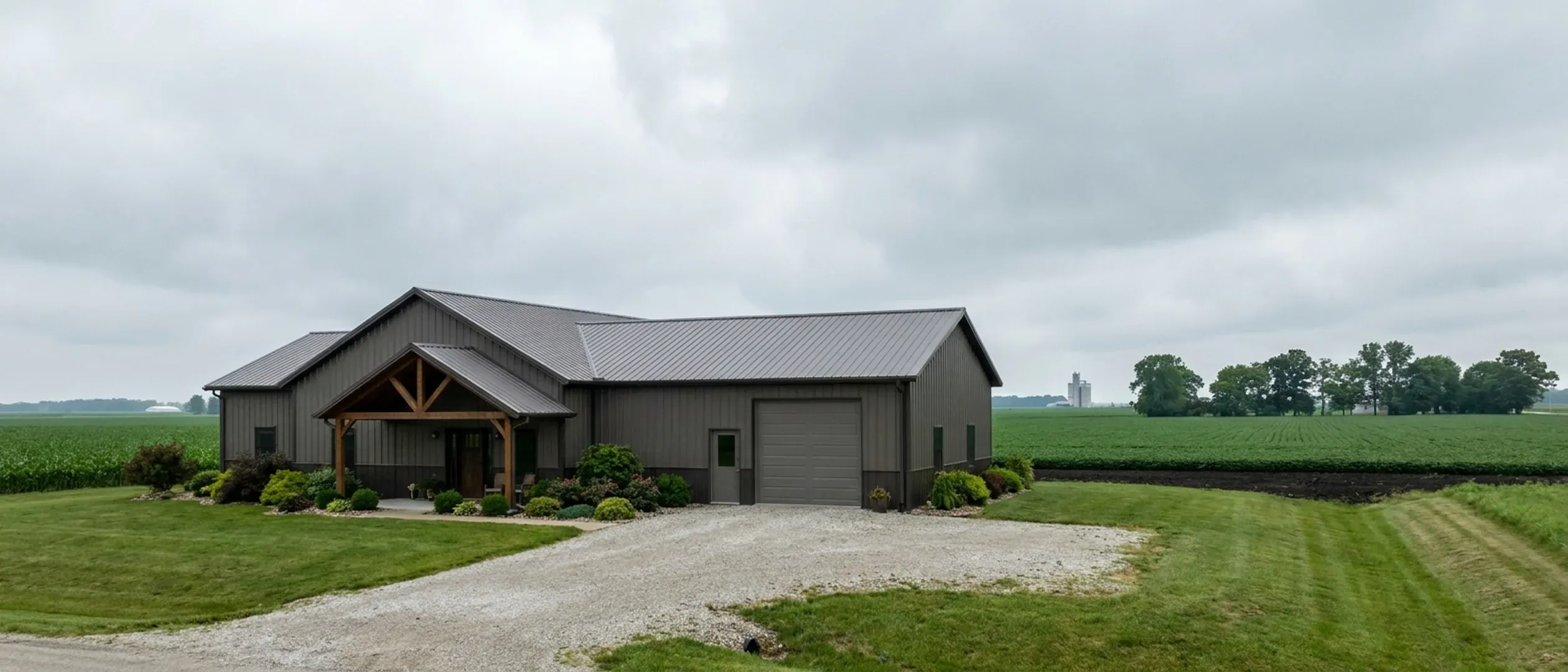
Barndominium Financing in Illinois: Loans, Appraisals, Paperwork
Most of the work in financing a barndominium is the same as financing any new custom home: a loan that pays the builder in stages while the home goes up, then a long-term mortgage once it is finished. Two things make it harder. The appraisal has to find comparable sales for a building type that may be rare near you, and in parts of Illinois there is no local building inspector to vouch for the work. This guide explains the loan structures in general terms and lists the Illinois documents that answer a lender's questions. It is general information, not financial advice: rates, terms and eligibility come from your lender.
Figures on this page are cited third-party or government data, not a quote from Illinois Barndominium Builders.
Bottom Line Up Front
- A barndominium is usually financed like any custom home: a construction loan paid out in draws, followed by a permanent mortgage. Whether a particular lender will do it depends on its own rules and on the appraisal.
- The appraisal is the step to plan for. It values the home against comparable sales, and where few barndominiums have sold nearby it can come in below the cost to build.
- Illinois paperwork helps: a permit and inspections where your city, village or county has a code, the residential code named in your contract where it does not, plus the septic and well permits.
The loan structures, in plain terms
Lenders name and package these differently. Ask each lender which it offers for a post-frame or steel home.
Construction-to-permanent loan
One loan, one closing. It pays the builder in draws during construction and converts to a long-term mortgage when the home is finished. It saves a second closing but locks you to one lender.
Construction loan, then a separate mortgage
A short-term loan covers the build, and a new mortgage pays it off at completion. There are two approvals, and the second depends on the finished home appraising well.
Land loan or land already owned
If you own the land before you build, lenders often treat equity in it as part of the down payment. Ask how your lender values land you already own.
Shell first, financing later
Some owners pay for a shell from savings and finance at completion. Before choosing this route, ask a lender what it needs to see at the end, because unpermitted or undocumented work is hard to finance later.
The appraisal is the step to plan for
Why comparable sales matter
An appraiser estimates value from similar homes that have sold nearby. Where barndominium sales are scarce, the appraiser may compare to conventional homes and adjust, and the result may not match the build cost. The loan amount follows the appraisal, not the construction contract.
How the shop is counted
Finished, heated living area is valued differently from shop or garage space. A plan that is mostly shop can have a building cost well above what the living area appraises for. Ask the lender how its appraisers treat attached shop space.
Describe it as a home
A barndominium someone lives in is a single-family home. Plans, permit records and the contract should say so, with finished living area, bedrooms and baths stated clearly, the same way a conventional house would be described.
The Illinois paperwork a lender is likely to ask for
Plans and specifications
A complete plan set and a written specification. Where your county requires sealed drawings, such as Will County for every new one- and two-family home, the seal is part of the set.
Building permit and inspections, where they exist
Inside a city or village, or in a county with an adopted code, the permit and inspection records show the work was checked. The Capital Development Board publishes the Illinois Code Directory of adopted local codes.
The code named in your contract
Where no local code applies, the contract clause required by the Illinois Residential Building Code Act shows which residential code the home is built to.
Septic and well approvals
A septic permit based on the required soil investigation, with at least three borings (77 Ill. Adm. Code 905.55), and a well permit issued before drilling (77 Ill. Adm. Code 920.130). A lender cannot finance a home without approved water and wastewater.
Energy code and radon
The Illinois Energy Conservation Code applies to the living space, and Illinois law requires a passive radon pipe in every new home (420 ILCS 52/20). Keeping records of both answers questions before they are asked.
Before you apply
Talk to more than one lender
Local banks, credit unions and agricultural lenders differ in whether they finance post-frame and steel homes and how they appraise them. Ask each one directly, early.
Have the land and site numbers ready
Lenders look at the whole project. The land price, septic, well, driveway and power are part of it, and on a rural parcel they can be a large share. USDA puts the 2026 average for Illinois farm real estate at $9,250 an acre.
Ask for the draw schedule in writing
Know when each draw is released, who inspects before it is paid and how interest is charged during construction. Match it to the builder's payment schedule before either is signed.
Keep a contingency
If the appraisal or a change order leaves a gap, the difference usually comes from your own funds. Ask the lender how it handles cost overruns.
Reading this because you are weighing a build? The next step is a plan drawn for your program.
What's different about Illinois
No state inspection to point to
The Capital Development Board says the State of Illinois does not review plans, issue permits or inspect privately funded homes. If a lender wants inspection records, they come from your city, village or county, where it has adopted a code.
The contract names the code where no local code applies
In areas with no local building code, the Illinois Residential Building Code Act (815 ILCS 670) requires a new-home contract to name the residential code the home will be built to. If none is named, the current International Residential Code, the Illinois Energy Conservation Code and the Illinois Plumbing Code become part of the contract by law. That clause is a document you can show a lender.
County occupancy permits
Illinois law lets a county board require an occupancy permit for each newly built home outside cities and villages (55 ILCS 5/5-1063). Unincorporated Cook County issues certificates of occupancy through its Department of Building and Zoning. Ask your county whether it issues one, because a lender converting a construction loan may ask for it.
Farm or residence for tax purposes
Illinois excludes property used primarily as a residence from the definition of a farm for assessment (35 ILCS 200/1-60). A lender estimating your property taxes will treat a barndominium on a hobby acreage as a home. Your county assessor decides the classification.
Is this financial advice?
Can you get a 30-year mortgage on a barndominium?
Why are barndominiums harder to finance?
My county has no building code. Can I still get a loan?
How are construction loan payments figured?
Does owning my land help?
Can I call it an agricultural building to avoid permits?
Do I pay property taxes on a barndominium in Illinois?
Questions answered? Tell us what you want to build and we will put real numbers against it.
Keep reading
The pages that answer the next question this one raises.
How much a barndominium costs in Illinois
Census and NAHB benchmarks and Illinois land values, for the budget a lender will look at.
Read itWhat size can I build for my budget?
Turning a loan amount into a realistic footprint.
Read itCan you build a barndominium in Illinois?
Codes, permits and zoning for a barndominium you live in.
Read itPermitting
The permit and inspection records a lender may ask to see.
Read itWant a real number instead of a range?
Start your plans and we will come back with a budget for what you actually want to build, not a national average. Send the parcel ID or an address when you have one and we will price it against your land. That conversation costs nothing.