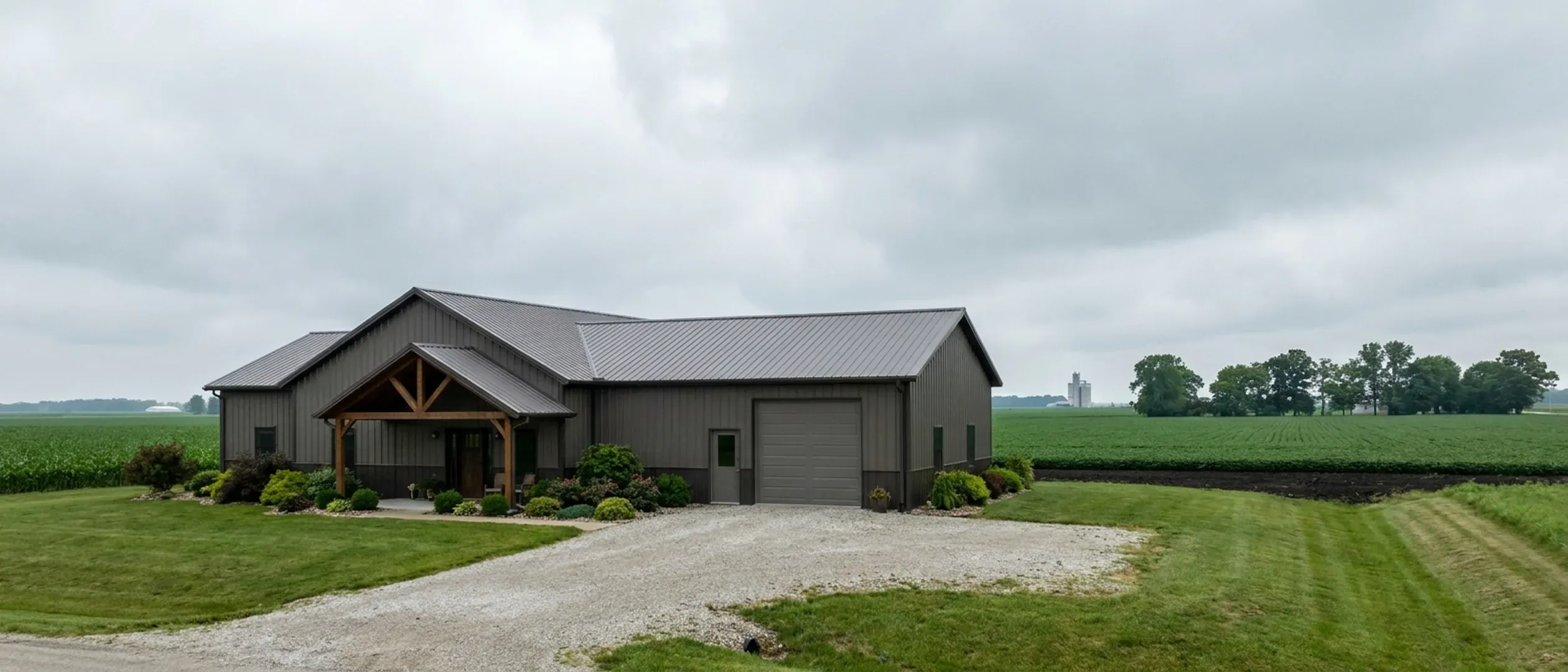
What Size Barndominium Can I Build for My Budget in Illinois?
The question people ask is how big a barndominium a budget will build. The honest way to answer it is backwards: take the land and the rural site costs out first, then divide what is left by a published cost per square foot. This guide does that with the U.S. Census Bureau's 2025 Midwest benchmark for new custom homes and NAHB's national construction cost, both third-party figures, and then covers the Illinois county rules that can decide the size before the budget does.
Figures on this page are cited third-party or government data, not a quote from Illinois Barndominium Builders.
Bottom Line Up Front
- At the U.S. Census Bureau's 2025 Midwest median contract price of $194.09 per square foot, $100,000 covers about 515 finished square feet, $200,000 about 1,030 and $300,000 about 1,546, all before land and site work.
- Land, septic, well, power and driveway come out of the budget first. On a rural Illinois lot they can take a large share of it.
- A shop bay, a shell finished over time, or a kit changes the math, because those square feet cost far less than finished living space.
What actually moves the number
Land comes first
USDA's 2026 Land Values Summary puts Illinois farm real estate at $9,250 an acre on average. Farm-scale averages are a starting point only: a small home site can sell for much more per acre. Whatever you pay comes straight off the building budget.
Septic, well and power
Off sewer, a septic system designed from at least three soil borings (77 Ill. Adm. Code 905.55) and a permitted well (77 Ill. Adm. Code 920.130) are fixed costs that do not shrink with a smaller house. Neither does the run to the nearest power line.
How much is shop
The Census benchmark is for finished homes. Square feet of open shop cost far less than square feet of kitchen, bath and bedroom, so the same budget buys a bigger building if a large share of it is shop.
Finish now or later
A dried-in shell with the living area finished first spreads the cost over time. The Census figures describe complete homes, so a shell scope sits below them.
Work the budget in this order
1. Land
Price the parcel, or set aside what you would pay for one. Confirm the zoning allows a home on it and what minimum lot size applies.
2. The rural site package
Septic soil work and system, well, electric service, driveway and grading. These are the costs a city lot would not have, and they are not in any Census per-square-foot figure.
3. Fixed code items
The passive radon pipe required in every new Illinois home (420 ILCS 52/20), energy-code insulation on the living space, and sealed drawings where your county asks for them, as Will County does for every new one- and two-family home.
4. What is left, divided by a benchmark
Divide the remaining money by a published cost per square foot to get a realistic finished size. Then decide how much of the building is living space and how much is shop.
Budget to size, at published benchmarks
Each line divides a building budget (after land and site work) by the U.S. Census Bureau's 2025 Midwest median and average contract price per square foot for new custom homes. None of these is our price.
$100,000 building budget
About 515 finished square feet at the Census Midwest median, about 495 at the Census average. Realistic as a small finished cabin-style home, or as a larger shell finished over time.
$150,000 building budget
About 773 finished square feet at the Census Midwest median, about 742 at the Census average.
$200,000 building budget
About 1,030 finished square feet at the Census Midwest median, about 990 at the Census average. Enough for a compact two-bedroom home, or a smaller living area beside an unfinished shop.
$250,000 building budget
About 1,288 finished square feet at the Census Midwest median, about 1,237 at the Census average.
$300,000 building budget
About 1,546 finished square feet at the Census Midwest median, about 1,484 at the Census average. A three-bedroom layout becomes realistic here.
$400,000 building budget
About 2,061 finished square feet at the Census Midwest median, about 1,979 at the Census average. This is the budget range the Census benchmark points to for a finished 2,000 square foot home.
The national construction-only view
NAHB's 2024 national survey put builders' construction cost at about $162 per square foot. On that basis $300,000 covers roughly 1,850 square feet, but NAHB's figure is a national average of construction cost only, without the builder's overhead and profit a buyer pays.
County rules that can cap the size first
Accessory building height
If the shop is a separate building, zoning may cap its height. Champaign County allows a residential accessory building up to 24 feet on lots of an acre or more and 15 feet on smaller lots. Madison County's zoning booklet caps accessory buildings at 25 feet in its agricultural and conservation districts and 20 feet in residential districts. A tall sidewall for an RV door can hit these limits.
Homes on agricultural land
Kendall County's one-home-per-40-acres rule on agriculturally zoned land means the land, not the building, can be the largest cost. Other counties set their own minimums.
Septic and the building footprint
The Illinois Private Sewage Disposal Code requires the seepage field's reserved area to stay free of driveways, accessory buildings and slabs. On a small lot, a large shop apron can compete with the septic field for space.
Getting more building from the same budget
Keep the footprint simple
A rectangle under one roof line uses the frame most efficiently. Every jog, gable and porch adds cost that the square footage does not show.
Put the shop under the same roof
One foundation perimeter and one roof for both uses cost less than two separate buildings of the same total size.
Finish in phases
Finish the living area first and leave a loft, bonus room or part of the shop for later. Plan the rough plumbing and electrical so the later work does not mean tearing out finished surfaces.
Reading this because you are weighing a build? The next step is a plan drawn for your program.
What's different about Illinois
County zoning can set your minimum acreage
Illinois lets counties set a minimum lot size for residences on land used for agriculture (55 ILCS 5/5-12001). Kendall County, for example, allows in general one home for each 40 acres of agriculturally zoned property. Check this before you price land.
Septic can set a minimum lot
Madison County permits private sewage disposal systems only on lots of at least 40,000 square feet. Other counties set their own rules, so ask the county health department.
Local design figures set structure cost
Frost depth and snow load come from your city, village or county, not the state. Several northern and collar counties publish a 42-inch frost depth, and snow loads range from 20 psf in Peoria County to 30 in McHenry, Kane and Winnebago counties.
How big of a barndominium can I build for $100,000?
How big of a barndominium can I build for $200,000?
How big of a barndominium can I build for $300,000?
How much does a 2,000 sq ft barndominium cost to build?
Should the budget include the land?
Can I build the shell now and finish it later?
Does a bigger shop change what I can afford?
Questions answered? Tell us what you want to build and we will put real numbers against it.
Keep reading
The pages that answer the next question this one raises.
How much a barndominium costs in Illinois
The full cost guide, with a calculator built on the same third-party benchmarks.
Read itFinancing a barndominium
How a construction loan fits the budget, and what a lender asks for.
Read itBarndominium kits
A kit or shell as a way to fit a smaller budget.
Read itSite preparation
The septic, well, driveway and pad work that comes out of the budget first.
Read itWant a real number instead of a range?
Start your plans and we will come back with a budget for what you actually want to build, not a national average. Send the parcel ID or an address when you have one and we will price it against your land. That conversation costs nothing.