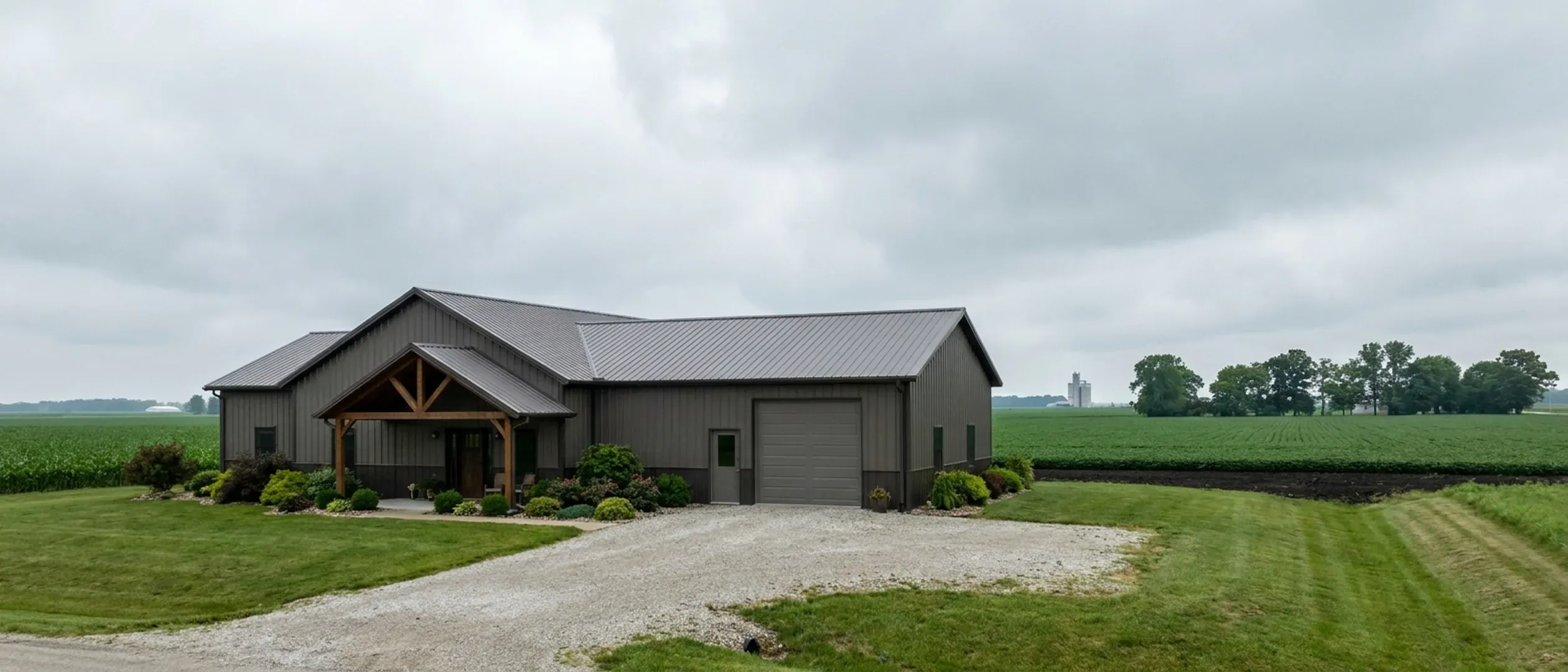
How Much Does a Barndominium Cost in Illinois? (2026 Data)
No government source publishes a barndominium price for Illinois. Census and NAHB cost data do not separate barndominiums from other new homes, and the Census tables report regions, not states. What does exist is solid: the U.S. Census Bureau's contract prices for new custom homes in the Midwest, NAHB's national survey of what builders spend, and USDA and ISPFMRA figures for Illinois land. This guide uses those numbers, labels each one for what it covers, and then walks through the Illinois items (septic soil borings, well permits, frost footings, the energy code, the radon pipe) that decide where your own build lands.
Figures below are industry data from cited third-party sources, not a quote from Illinois Barndominium Builders. Every project is priced individually.
Bottom Line Up Front
- The best benchmark: the U.S. Census Bureau puts the 2025 median contract price for a new contractor-built home in the Midwest at $194.09 per square foot (average $202.13), not counting land. The Midwest is a 12-state Census region that includes Illinois, so treat this as a regional figure for new custom homes of every kind, not an Illinois barndominium price.
- Land is a separate line. USDA's 2026 Land Values Summary puts average Illinois farm real estate at $9,250 an acre and Illinois cropland at $10,200 an acre.
- The costs that make an Illinois build different sit outside the building: a septic design based on at least three soil borings, a well permit before drilling, footings as deep as your county's published frost line, and the passive radon pipe that Illinois law requires in every new home.
Published cost per square foot
Third-party benchmarks for new homes. None is a barndominium-only or Illinois-only figure, and none is our price. Your land, site work and finish level decide where a build lands.
| Benchmark | Range | Source |
|---|---|---|
| New custom home on the owner's land, Midwest, 2025 (median to average) | $194–$202 per sq ft, land excluded | U.S. Census Bureau, Characteristics of New Housing: median ($194.09) and average ($202.13) contract price per sq ft of new contractor-built single-family houses started, Midwest region, 2025. https://www.census.gov/construction/chars/xls/contractpricesqft_cust.xls |
| New custom home on the owner's land, Midwest, 2023 to 2025 medians | $184–$198 per sq ft, land excluded | U.S. Census Bureau, Characteristics of New Housing: Midwest median contract price per sq ft of contractor-built houses started, $183.62 (2024) to $197.57 (2023). https://www.census.gov/construction/chars/xls/contractpricesqft_cust.xls |
| New custom home on the owner's land, whole U.S., 2025 (median to average) | $172–$198 per sq ft, land excluded | U.S. Census Bureau, Characteristics of New Housing: U.S. median ($171.57) and average ($198.33) contract price per sq ft of contractor-built houses started, 2025. https://www.census.gov/construction/chars/xls/contractpricesqft_cust.xls |
| New home bought from a builder, Midwest, 2025 (median to average) | $160–$170 per sq ft, lot value excluded | U.S. Census Bureau, Characteristics of New Housing: Midwest median ($160.00) and average ($169.78) price per sq ft of new detached single-family houses sold, 2025. https://www.census.gov/construction/chars/xls/soldpricesqft_cust.xls |
| Builders' construction cost only, national (NAHB, 2022 and 2024) | $153–$162 per sq ft, construction only | NAHB (Eric Lynch), Cost of Constructing a Home-2024, January 20, 2025: average construction cost about $162 per sq ft in 2024, $153 in 2022. https://www.nahb.org/news-and-economics/housing-economics-plus/special-studies/special-studies-pages/cost-of-constructing-a-home-in-2024 |
Estimate a range for your square footage
Pick a size and a benchmark and this multiplies them against the same industry ranges printed in the table above, nothing new, nothing ours. It's a starting orientation, not a quote.
Estimated range
$0 – $0
This estimate comes from the third-party cost data cited in the table above, not from Illinois Barndominium Builders. It doesn't account for your site, county, or finish choices, all of which move the real number. Send us the parcel for one that does.
Total cost by size
Rough totals at common sizes. These move with everything on this page, so treat them as a starting orientation, not an estimate for your project.
1,500 sq ft
$291,135–$303,195
Arithmetic: 1,500 sq ft times the U.S. Census Bureau 2025 Midwest median ($194.09) and average ($202.13) contract price per sq ft for new contractor-built homes. Land, well, septic and driveway not included.
2,000 sq ft
$388,180–$404,260
Arithmetic: 2,000 sq ft times the U.S. Census Bureau 2025 Midwest median ($194.09) and average ($202.13) contract price per sq ft for new contractor-built homes. Land, well, septic and driveway not included.
2,500 sq ft
$485,225–$505,325
Arithmetic: 2,500 sq ft times the U.S. Census Bureau 2025 Midwest median ($194.09) and average ($202.13) contract price per sq ft for new contractor-built homes. Land, well, septic and driveway not included.
3,000 sq ft
$582,270–$606,390
Arithmetic: 3,000 sq ft times the U.S. Census Bureau 2025 Midwest median ($194.09) and average ($202.13) contract price per sq ft for new contractor-built homes. Land, well, septic and driveway not included.
What actually moves the number
The land, priced separately
None of the Census per-square-foot figures include land. For Illinois, USDA's 2026 Land Values Summary puts farm real estate at $9,250 an acre and cropland at $10,200 an acre. Those are farm-scale averages, so a small home site can sell at a very different price per acre. Zoning can also set the acreage for you: county zoning may set a minimum lot size for homes on farmland (55 ILCS 5/5-12001), and Kendall County allows, in general, one home per 40 acres of agriculturally zoned land.
Septic and well on a rural lot
Off sewer, the septic design starts with a soil investigation: at least three borings per absorption site, at least 50 feet apart, done by a soil classifier or a professional engineer (77 Ill. Adm. Code 905.55). A new well needs a permit from IDPH or the local health department before drilling, and the Water Well Construction Code caps that permit fee at $100 (77 Ill. Adm. Code 920.130). If a sanitary sewer is within 300 feet, a new septic system will not be approved (905.20).
Footing depth your county publishes
Footings go below the frost line the local code sets, and that is a county or city figure, not a state one. McHenry, Kane, Will, DeKalb, Winnebago and Peoria counties each publish a 42-inch frost depth. Tazewell County's garage handout uses 36 inches. On a post-frame building every post hole goes to that depth, so it is a real line item.
Snow load on a wide roof
Barndominiums often have long clear-span roofs, and the snow load the trusses are designed for is set locally. Peoria County publishes a 20 psf ground snow load. McHenry, Kane and Winnebago counties publish 30. Will County lists 30 psf when taking reductions or 25 psf roof load without them. A heavier design load means heavier framing.
Sealed drawings where required
Will County requires every new one- and two-family home in its jurisdiction to have documents signed and sealed by a registered design professional, or as approved by its chief building official. Kane County requires sealed designs for pier-supported detached accessory buildings. Budget for a design professional's fee wherever your county asks for a seal.
The energy code on the living space
The Illinois Energy Conservation Code (the 2024 IECC with Illinois amendments, in effect since November 30, 2025, per the Capital Development Board) covers the conditioned part of a barndominium. Insulation, windows and air sealing are sized to it. An unheated shop bay is not conditioned space.
The radon pipe
Illinois law requires passive radon-resistant construction, a vent pipe installed during construction, in every new single-family home (Radon Resistant Construction Act, 420 ILCS 52/20). It is a small item, but it belongs in the budget from day one. Adding a fan later is work for a radon contractor.
Driveway and finish site work
Long rural driveways add up. In NAHB's 2024 national builder survey, the average driveway cost $9,635 and landscaping $9,269, on lots far smaller than a typical acreage home site. Treat those as national reference points, not Illinois prices.
The per-square-foot numbers, and what each one measures
Every figure below comes from a named third party. None is ours, and none is a barndominium-only number.
Census contract price: the closest match to a barndominium
The U.S. Census Bureau's contract-price series covers new homes built on the owner's land under contract with a builder, which is how barndominiums are usually built. For the Midwest the Census median was $197.57 per square foot in 2023, $183.62 in 2024 and $194.09 in 2025, all excluding the lot. The Census 2025 median for the whole country was $171.57.
How spread out Midwest prices are
The same Census table reports that 69% of contractor-built homes started in the Midwest in 2025 had a contract price of $150 per square foot or more, against 61% nationally. The median is a middle, not a floor.
Census sold-home price: a spec-home comparison
For new detached homes sold by builders, the Census reports a 2025 Midwest median of $160.00 per square foot, with lot value excluded. These are mostly tract and spec homes, so they are useful as a comparison, not as a custom-build estimate.
NAHB: what builders actually spend
NAHB's 2024 survey of builders put average construction cost at $428,215, about $162 per square foot, for an average 2,647-square-foot home. Construction was 64.4% of the average sales price and the finished lot 13.7%. It is a national survey, not an Illinois one.
Why there is no Illinois barndominium figure
Census publishes these tables by region, and neither Census nor NAHB separates barndominiums from other homes. A barndominium price per square foot that claims to be Illinois-specific is someone's estimate, so ask who made it and when.
What a 2,000 sq ft barndominium costs, worked from the benchmarks
This is the most asked size, so here is the arithmetic laid out. It is orientation, not a quote.
The building
At the U.S. Census Bureau's 2025 Midwest median of $194.09 per square foot, 2,000 square feet comes to about $388,180. At the Census Midwest average of $202.13 it comes to about $404,260. Both exclude land.
The land
At USDA's 2026 Illinois farm real estate average of $9,250 an acre, five acres would come to about $46,250. That average covers farm-scale sales, so check recent sales of home-sized parcels in your county.
The site
Add the septic system, well, electric service, driveway and grading. None of those is in the Census per-square-foot figure when you build on raw land, and on a rural Illinois lot they depend on soils, distance to the road and distance to power.
What changes the result
A barndominium with a large shop bay has fewer finished square feet per square foot of building, so the finished-home benchmark overstates the shop and understates a high-finish living area. Price the two parts separately.
What $100,000, $200,000 or $300,000 builds
These answer the budget questions people ask most, using the same Census 2025 Midwest benchmark. Land and site work must come out of the budget first.
$100,000
Divided by the Census 2025 Midwest median of $194.09 per square foot, $100,000 covers about 515 finished square feet of new custom home, or about 495 at the Midwest average. That is before land, well and septic. A larger building on this budget means a smaller scope, such as a shell you finish over time.
$200,000
At the same Census Midwest median, $200,000 covers about 1,030 finished square feet (about 990 at the average), again with land and site costs on top.
$300,000
At the Census Midwest median, $300,000 covers about 1,546 finished square feet (about 1,484 at the average). A three-bedroom plan with a modest shop is possible at that size, but the site budget decides how much of the budget reaches the building.
Kits and shells are a different scope
The Census figures are for finished homes. A metal kit or a dried-in shell costs less per square foot because it leaves the interior, mechanicals and finishes for later. No public source publishes an Illinois shell price, so price a kit against a named supplier's dated quote.
Illinois land: what the published values say
USDA farm real estate and cropland
USDA NASS's 2026 Land Values Summary puts Illinois farm real estate (land and buildings) at $9,250 an acre, up 3.6% from $8,930 in 2025, and Illinois cropland at $10,200 an acre, up from $9,850.
ISPFMRA farmland sales
The Illinois Society of Professional Farm Managers and Rural Appraisers reported that average-quality farmland sold for an average of $9,933 an acre in 2025, and excellent-quality farmland for $15,846 an acre.
What those figures leave out
Both describe farmland sold as farmland. A small parcel split off for a house, a wooded lot or land near a growing town can price very differently per acre. County zoning may also require a minimum lot size for a home on agricultural land, which sets how many acres you have to buy.
How to price your own parcel
1. Find who has jurisdiction
Inside a city or village, that municipality's code and permits apply. Outside, it is the county, if the county has adopted a code. The Capital Development Board publishes the Illinois Code Directory of adopted codes.
2. Get the county's design figures
Ask the permit office for its frost depth and ground snow load, and whether it requires sealed drawings for a new home. These set foundation and framing cost.
3. Order the soil work early
The septic borings tell you whether a conventional seepage field works on the parcel. Keep the future field clear of the driveway and shop apron: the Private Sewage Disposal Code requires that reserved area to stay free of driveways, accessory buildings and slabs.
4. Then size the building
With land and site costs known, divide what is left by a benchmark per square foot to see a realistic size, and choose which parts are finished living space and which are shop.
Reading this because you are weighing a build? The next step is a plan drawn for your program.
What's different about Illinois
Your permit comes from your city, village or county
Illinois does not issue residential building permits. The Capital Development Board says the state does no plan reviews, permits or inspections for privately funded homes. Where a local code applies, its fees and inspections are part of your cost. Since January 1, 2025, any code a city, village or county adopts must regulate structural design at least as strictly as the International Residential Code (20 ILCS 3105/10.18).
No local code still means a code
Where no local building code applies, the Illinois Residential Building Code Act (815 ILCS 670) says a new-home contract must name the residential code the home will be built to. If it names none, the current International Residential Code, the Illinois Energy Conservation Code and the Illinois Plumbing Code become part of the contract by law. Price a build to the code it will actually meet.
Radon and energy rules apply everywhere
The passive radon pipe (420 ILCS 52/20) and the Illinois Energy Conservation Code (20 ILCS 3125) apply to new homes across the state. The Capital Development Board says you must comply with the energy code even where no one enforces it.
Farm land is not a tax discount on the house
A farm dwelling is assessed as part of the farm, but Illinois excludes property used primarily as a residence from the definition of a farm (35 ILCS 200/1-60). A home on a hobby acreage is residential. Ask your county assessor before you count on any farm treatment.
What is the average cost to build a barndominium in Illinois?
How much does a barndominium cost per square foot in Illinois?
How much would a 2,000 sq ft barndominium cost to build?
How big of a barndominium can I build for $100,000, $200,000 or $300,000?
Is land or the building the bigger cost in Illinois?
Do I need soil tests and a well permit before I build?
Do you pay property taxes on a barndominium in Illinois?
Why don't you publish your own price per square foot?
Questions answered? Tell us what you want to build and we will put real numbers against it.
Keep reading
The pages that answer the next question this one raises.
What size barndominium can I build for my budget?
Working backwards from a budget to a footprint, after land and site work come out.
Read itBarndominium vs. house cost
Where the two genuinely differ on cost, and what cannot be compared honestly.
Read itFinancing a barndominium
Construction loans, appraisals and the paperwork a lender will ask for.
Read itSite preparation
Driveway, pad, drainage, well and septic coordination on a rural Illinois lot.
Read itPermitting
Who issues the permit for your parcel, and what the county asks for.
Read itWant a real number instead of a range?
Start your plans and we will come back with a budget for what you actually want to build, not a national average. Send the parcel ID or an address when you have one and we will price it against your land. That conversation costs nothing.