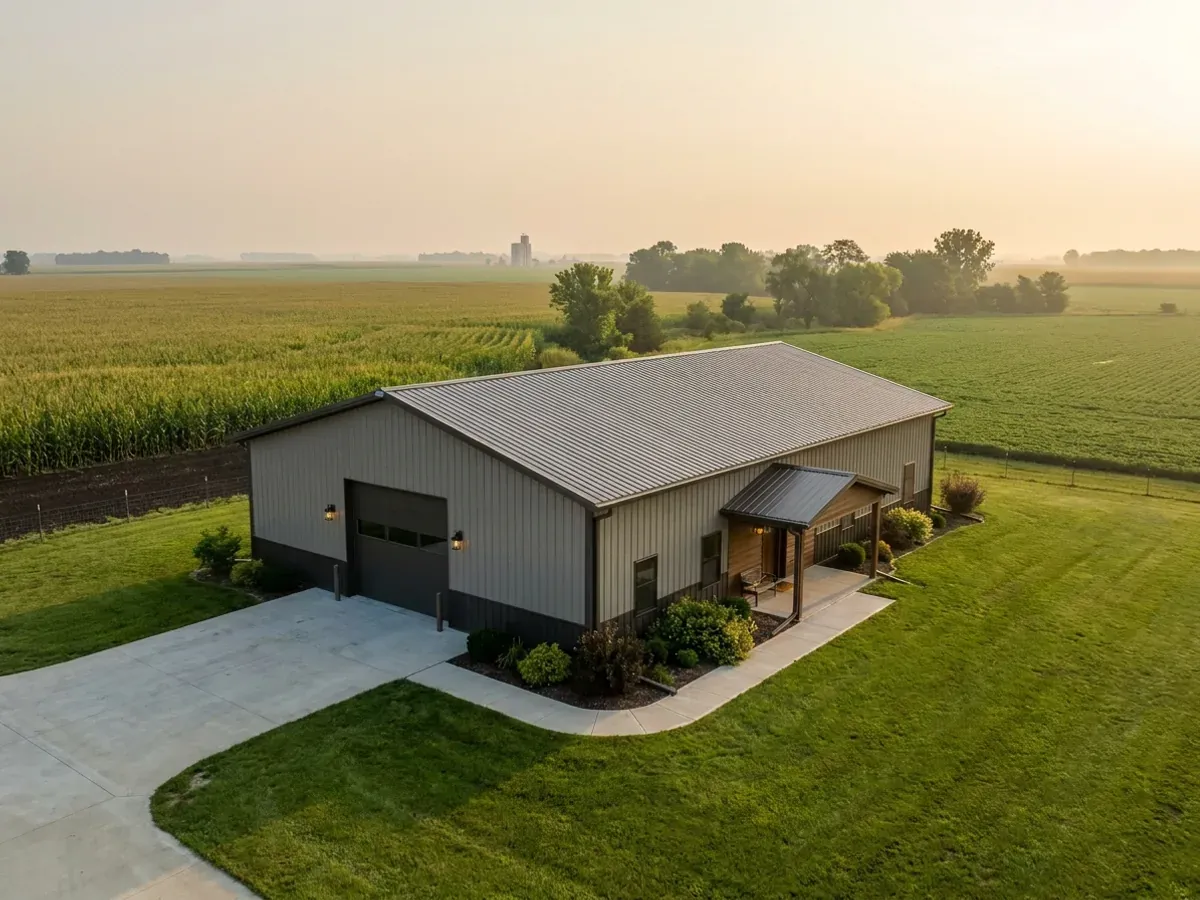
Turnkey Builds in Illinois
A turnkey build is one contract and one point of contact from raw land to the day you get the keys. Most people searching for barndominium builders in Illinois are really looking for someone to take the whole job off their plate, and that is what this service is. We confirm what your parcel allows, line up the permit with your city, village or county, schedule the soil borings and septic permit through the county health department, get the well permitted before drilling starts, and manage the site work, foundation, frame, shell and interior finish in sequence. Licensed trades do the licensed work: an Illinois-licensed roofing contractor installs the roof and Illinois-licensed plumbers do the plumbing, and we coordinate them inside one schedule. You make the decisions that matter, such as floor plan, finishes and budget priorities, and you get one schedule and one person to call instead of a dozen.
Turnkey Builds: how the work runs
Four stages, in this order. The sequence matters more than it looks: getting the structural design and permitting settled before anything is fabricated is what keeps a build from stalling.
Land and feasibility
Before anything is drawn we look at the parcel: whether it sits inside a city or village or in unincorporated county territory, what the zoning allows for a residence, whether a sanitary sewer is close enough to connect to, and where the septic field, well, house and driveway can all fit. Some counties limit homes on agricultural land; Kendall County, for example, generally allows one home per 40 acres of agriculturally zoned property. Finding that out before you close on land is far cheaper than after.
Plan, price and one contract
We settle the floor plan, finishes and building system with you, then put the whole job into one contract. Where your parcel has no local building code, Illinois law (the Illinois Residential Building Code Act, 815 ILCS 670) requires the contract for a new home to name the residential code it will be built to, and if none is named, the current International Residential Code, the Illinois Energy Conservation Code and the Illinois Plumbing Code become part of the contract by law.
Permits, septic and well
Illinois does not issue residential building permits; your city, village or county does, if it has adopted a building code. We prepare and file that application, and we schedule the rest in parallel: the soil investigation the state septic code requires, the septic permit through your county health department, and the well permit from the Illinois Department of Public Health or the approved local health department before any drilling starts.
Barndominium builders near me, start to finish
Once permits are in hand we run the site work, foundation, frame, shell, mechanicals and interior finish as one sequence, with inspections booked where your jurisdiction inspects. The metal roof is installed by a licensed Illinois roofing contractor we coordinate, plumbing is done by Illinois-licensed plumbers, and passive radon piping goes in under the slab as Illinois law requires for every new home. You get regular updates from one contact, a final walkthrough and the keys.
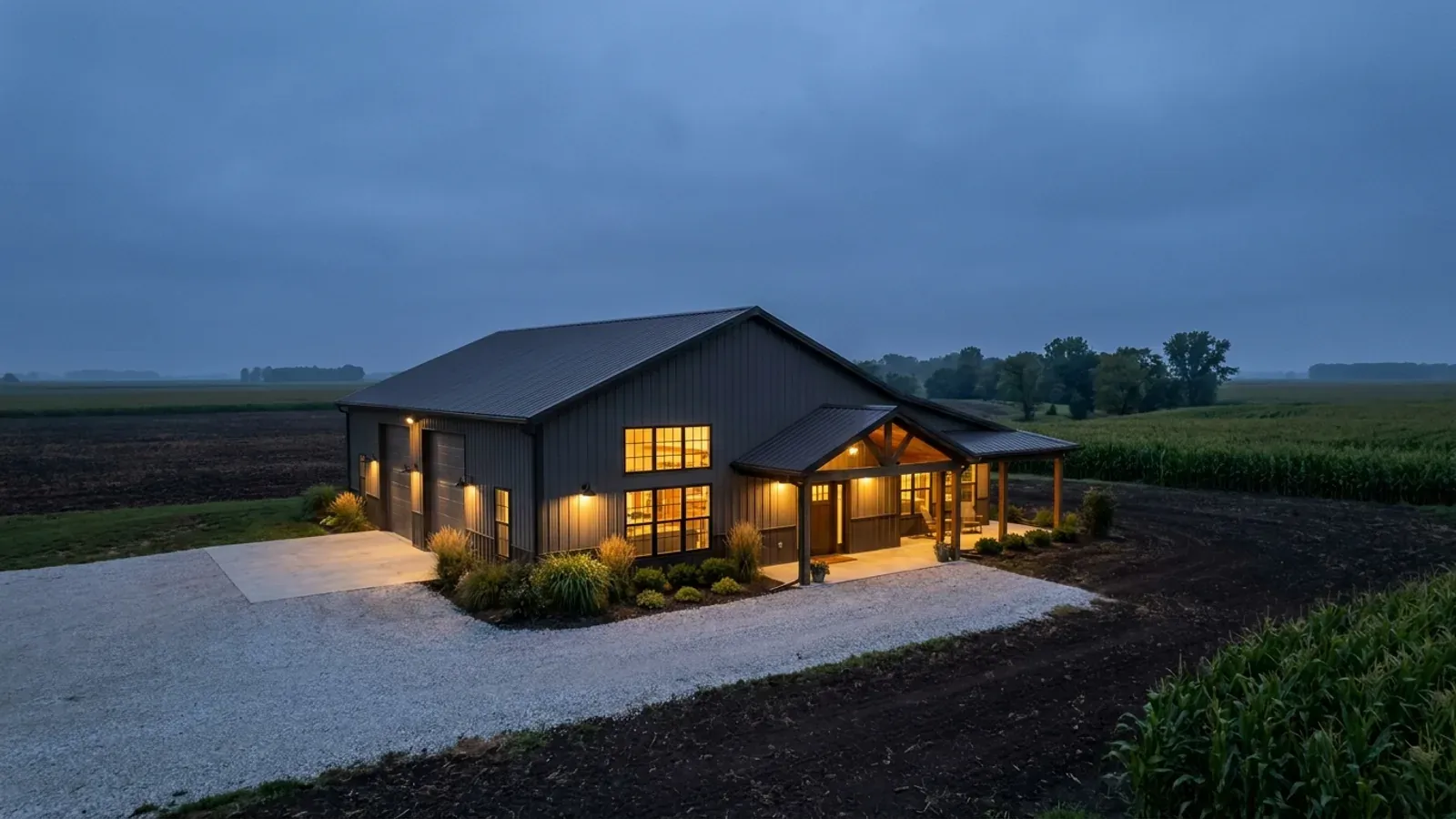
Illinois leaves building rules to your city, village or county, so a turnkey build starts with your parcel
The State of Illinois does not issue residential building permits or inspect private homes; if either is required, it is handled by the local government. Some counties enforce a recent International Residential Code in unincorporated areas, some cities run their own departments, and Chicago has its own construction codes. What every new home shares is a floor and a few statewide duties: since January 1, 2025 any local building code must regulate structural design at least as strictly as the International Residential Code (20 ILCS 3105/10.18), the Illinois Energy Conservation Code applies to new homes across the state, passive radon-resistant construction is required in every new home, and septic systems are designed to the Illinois Department of Public Health's Private Sewage Disposal Code. A turnkey contract means that sorting out which rules reach your parcel is our job, not yours.
Where we deliver turnkey builds
We deliver turnkey builds across Illinois, from the collar counties outside Chicago to Rockford, the Quad Cities, Peoria, Bloomington-Normal, Champaign, Springfield, Quincy, the Metro East and Southern Illinois. Cross a city or county line and what can change is who reviews the drawings, what they charge, and how the land is zoned, so we confirm the authority for your parcel first.
Serving clients across Illinois.
Every locality we build in has its own reviewer and its own fee schedule. The location pages set out who issues the permit in each one.
What actually decides the price
Square footage is the number everyone leads with, and it is rarely the one that moves a barndominium budget. These four do.
-
The parcel and how far utilities have to travel
A long driveway, a power run from the road, grading on a sloped lot or a wet low spot all add cost before the foundation starts. A parcel within reach of a sanitary sewer can skip a private septic system; under the Illinois Department of Public Health's code, a new private system is not approved where a sewer is available, which it defines as within 300 feet of a residential property.
-
Septic and well
A private septic field is sized from soil data. The state code calls for at least three soil borings, at least 50 feet apart, by a soil classifier or an Illinois-licensed professional engineer. Poor soils mean a larger or alternative system. A new well adds drilling, a pump and a permit, and the well has to be set back from the septic system and other contamination sources.
-
Size, layout and building system
Square footage, the number of bathrooms and exterior walls, ceiling height, a garage or shop bay, and the choice between a steel frame and a post-frame (pole barn) frame all move the budget. A simple rectangle with an open plan costs less per square foot to build than the same area broken into wings.
-
Finish level
Cabinets, countertops, flooring, fixtures, windows and doors are where turnkey budgets spread furthest. We price finishes as allowances you can see line by line, so you choose where to spend and where to save instead of discovering it at the end.
Turnkey Builds in Illinois: common questions
8 questions we get asked most often about building in Illinois. If yours is not on the list, ask it directly.
What does turnkey actually include?
Are you barndominium builders near me?
What should I ask barndominium builders in Illinois before signing?
Can you have a barndominium in Illinois?
If my county has no building code, do I still need a permit?
Is a barndominium on my farm exempt from the rules?
How long does a turnkey barndominium take?
Can I do some of the work myself?
Keep reading
The pages that answer the next question this one raises.
How Long Does It Take?
Census data on build duration, and why the permit step depends on which jurisdiction your parcel sits in.
Read itHow to Finance a Barndominium
A single contract is also the structure lenders are most comfortable underwriting.
Read itBarndominium Cost Guide
Sourced ranges for the finished tier, so the quote has context.
Read itReady to put turnkey builds against a real plan? Start there and the rest follows.
Tell us about the land
Send the parcel ID or an address and we will come back with what can be built on it, who issues the permit, and a realistic budget range. That conversation costs nothing.