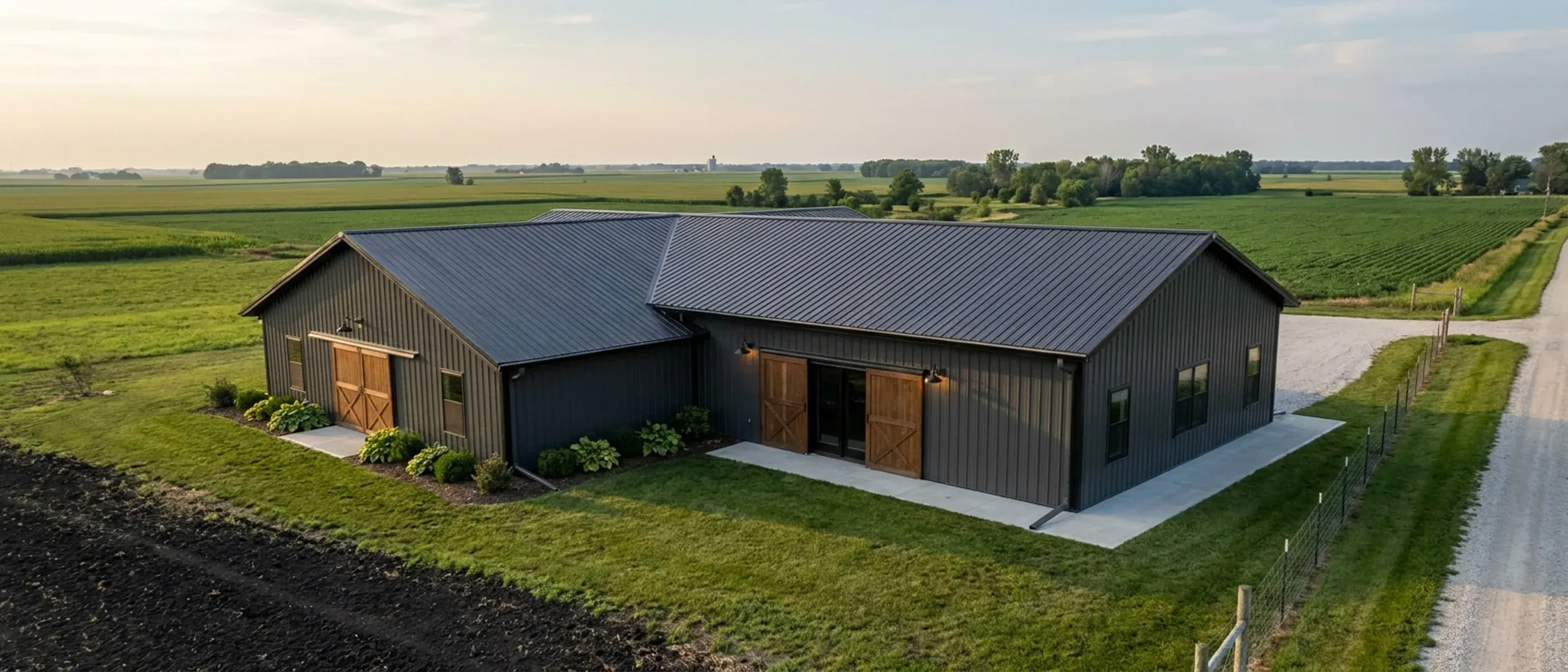
Are Barndominiums Worth It in Illinois? An Honest Answer
A barndominium is worth it when the building does something you need that a conventional house would do worse or at greater cost, usually combining a real workshop, equipment storage or a hobby space with a home under one roof. It is a poorer choice when you want the lowest price for a standard house in a subdivision, when you expect to sell within a few years, or when the parcel's zoning will not allow the shop you have in mind. In Illinois the decision also runs through the land. Good farmland here is expensive, county zoning often limits how many homes can go on agricultural land, property tax follows how the property is used, and the energy code applies to the living quarters whether anyone inspects them or not. This page sets out the cases where the answer is clearly yes, the cases where it is no, and the questions that settle it for your parcel.
Figures on this page are cited third-party or government data, not a quote from Illinois Barndominium Builders.
Bottom Line Up Front
- Worth it when you genuinely need shop or storage space you would otherwise build as a second building, and when you plan to hold the property long enough that resale matters less.
- In Illinois, land and zoning often decide the question before the building does: price the parcel, check the county's minimum lot size or density rule, and confirm the septic site first.
- Not worth it if the goal is simply the cheapest house: the living quarters cost what finished living space costs, and the energy code applies to them statewide.
When the answer is clearly yes
Each of these is a situation rather than a taste, and each turns on something the structure does well.
You need a real shop or equipment storage
If you would otherwise build a house and a separate pole building, one clear-span envelope shares the foundation, the roof and often the utility service. That is where the barndominium's cost advantage is real.
You want an open, adaptable plan
With no interior bearing walls, rooms can be sized freely and rearranged later. That suits owners who expect their needs to change or who want to finish space in stages.
You are building on your own rural acreage
A barndominium on land you own, outside a subdivision with appearance covenants, is the setting it was designed for. Check county zoning and the septic site first, then design to the lot.
You plan to stay
The longer you hold the property, the less resale variability matters and the more the shop space earns its keep in daily use.
You want a fast, weathertight shell
A post-frame or steel shell dries in quickly, which protects interior work through an Illinois winter and allows finishing in phases.
When the answer is no, or not yet
These are the situations where a conventional house, or a different parcel, is usually the better call.
You want the cheapest possible house
The shell may be economical, but kitchens, bathrooms, mechanical systems and finishes cost the same in any structure. Without a shop to share the envelope, the savings narrow.
The zoning will not allow it
A minimum lot size for residences, a density allocation, an accessory height cap, or subdivision covenants on appearance can rule out the building you want. Find out before closing on land.
The land will not take a septic system easily
A seepage field needs suitable soil proven by at least three borings (77 Ill. Adm. Code 905.55), and some counties set their own minimums, such as Madison County's 40,000 square foot lot minimum for private sewage systems. Poor soils can change the system and the budget.
You expect to sell soon
A less common building type can take longer to sell and can be harder to appraise where there are few comparable sales nearby. On a short horizon, that uncertainty weighs more.
You are in a dense part of the Chicago area
Chicago and unincorporated Cook County each have their own codes, and suburban lots rarely have room for a shop-plus-home building. The acreage for a barndominium is generally further out, in collar and downstate counties.
Resale, appraisal and lending, stated plainly
No reliable source gives an Illinois figure for barndominium resale value or appreciation, and we will not invent one. What can be said is where the uncertainty comes from and how to reduce it.
Appraisal depends on local comparables
An appraiser values the house against nearby sales. Where few barndominiums have sold, the appraisal draws on conventional homes and adjusts, which can go either way. Ask your lender how its appraisers handle the building type in your county.
Lenders treat shop space differently
Some lenders value a large shop inside the same envelope as living space and some do not. Ask before you fix the split between shop and living area, and ask whether the construction loan converts to a long-term mortgage.
Documentation protects value
A future buyer's lender will ask what the house was built to. Keep the permit and final inspection or occupancy permit where your jurisdiction issues them, or the construction contract naming the code under 815 ILCS 670 where it does not, plus the septic, well and radon records.
Quality shows at resale
A well-insulated, dry, properly finished barndominium sells as a house with a shop. One with condensation problems or a shed-grade interior sells as neither. The build quality of the living quarters decides which one you own.
Questions that settle it for your parcel
Work through these before committing to land or a design.
Does zoning allow a home here, and how big a shop?
Ask the county or municipal zoning office about minimum lot size, density rules, accessory height and any appearance standards.
Who issues the building permit?
The city or village inside its limits, the county if it has adopted a code, or nobody where no local code applies, in which case the contract must name the code.
Will the soil take a septic system, and is there a sewer nearby?
Three borings decide the septic design, and a new private system is not approved where a sanitary sewer is within 300 feet of the property (77 Ill. Adm. Code 905.20).
What will the land cost next to the building?
Illinois farmland prices are high by national standards; price the specific parcel, access, well and power before settling on building size.
How will your lender treat it?
Ask about appraisal, the treatment of shop space and the construction-to-permanent loan before you sign a build contract.
How long will you keep it?
The longer the horizon, the stronger the case for building exactly what you need rather than what resells most easily.
Reading this because you are weighing a build? The next step is a plan drawn for your program.
What's different about Illinois
Illinois land is a large part of the budget
USDA's Land Values 2026 Summary puts the average value of Illinois farm real estate at $9,250 an acre and Illinois cropland at $10,200 an acre. Illinois farm managers and rural appraisers (ISPFMRA) reported that average-quality farmland sold for about $9,933 an acre on average in 2025. A small rural parcel can price differently from those averages, but they show why a few extra acres are not a minor line item here.
Construction benchmarks are regional, not state
The U.S. Census Bureau's 2025 data put the median contract price for a new contractor-built home in the Midwest at about $194 per square foot, excluding land. That is a Midwest figure for all house types, not an Illinois barndominium price, and it is useful mainly as a sense-check on any quote you receive.
Property tax follows the use
Illinois assesses a farm dwelling as part of the farm, but property primarily used for residential purposes is not a farm even if some farm products are grown on it (35 ILCS 200/1-60). A barndominium on a residential acreage is assessed as residential property, so budget for residential taxes.
Zoning can limit homes on farmland
County zoning cannot regulate agriculture itself, but it may set a minimum lot size for residences on agricultural land (55 ILCS 5/5-12001). Kendall County, for example, generally allows one home for each 40 acres of agriculturally zoned property. That can make a small parcel unbuildable for a home, or require buying more land than planned.
The energy code applies to the living quarters
The Illinois Energy Conservation Code (the 2024 IECC with Illinois amendments since November 30, 2025) applies to new homes statewide, and the Capital Development Board says you must comply even where it is not enforced. The heated living area of a barndominium is built to the same energy standard as any new Illinois home.
Shop height can be capped
Champaign County limits a residential accessory building to 24 feet on lots of one acre or more and 15 feet on smaller lots; Madison County's zoning caps accessory height at 20 feet in residential districts and 25 feet in agricultural and conservation districts. If the shop is the reason for the barndominium, confirm what height and size the zoning allows before you buy.
Pros and cons, honestly
Pros
- A shop and a home under one envelope instead of two buildings.
- An open, adaptable plan with no interior bearing walls.
- A fast dry-in that protects interior work through the winter and allows phased finishing.
- Built on your own acreage, designed to your county's rules and your use.
- Living quarters built to the same Illinois energy code as any new home.
Cons
- Illinois land is expensive, and zoning may require more acreage than the building needs.
- Living space costs what living space costs; the savings come from the shop, not the house.
- Appraisal and resale are less predictable where few comparable sales exist.
- Zoning height and density limits can rule out the shop you want.
- A barndominium on a residential acreage is taxed as residential property, not farmland.
Are barndominiums worth it in Illinois?
Do you pay property taxes on a barndominium in Illinois?
Can you get a 30-year mortgage on a barndominium?
Do barndominiums last as long as a conventional house?
How much land do I need for a barndominium in Illinois?
What does land cost in Illinois?
Is a barndominium cheaper than building a house in Illinois?
Can you have a barndominium in Illinois?
Questions answered? Tell us what you want to build and we will put real numbers against it.
Keep reading
The pages that answer the next question this one raises.
Barndominium pros and cons
The structural trade-offs behind this decision, with the Illinois rules that shape them.
Read itAre barndominiums legal in Illinois?
Who issues your permit, what applies where there is no local code, and farmland zoning.
Read itBarndominium financing
Construction loans, appraisal and the records a lender asks for.
Read itShop houses
A working shop and living quarters under one roof, the case where a barndominium pays off most.
Read itSite preparation
Borings, septic layout, drive and pad for a rural Illinois parcel.
Read itWant a real number instead of a range?
Start your plans and we will come back with a budget for what you actually want to build, not a national average. Send the parcel ID or an address when you have one and we will price it against your land. That conversation costs nothing.